

Transferable Skills
Jon Sparks muses on deadlines and word counts in fiction and non-fiction.

I’ve written a wide range of outdoor books and articles over a span of more than thirty years. In the last few years, however, I’ve been concentrating on fiction. And this has set me thinking about the way the skills honed in one kind of writing transfer over to another, including the basics of professionalism. For instance: deadlines and word counts.
In the alternative universe of Facebook writers’ groups, I’ve seen people post, apparently without irony, Douglas Adams’s remark: “I love deadlines. I love the whooshing noise they make as they go by.”
After over 30 years, and 60 books, as an (award-winning) outdoor writer and photographer, Jon Sparks has recently switched his focus to fiction. Find out more from his website.
Maybe he did, and maybe he was enough of a genius to get away with it, although I wonder how well it went down in his days working on Doctor Who. Anyway, I don’t believe this is good life advice for 99.9% of us, and it’s definitely unhelpful in groups frequented by inexperienced or aspiring writers.
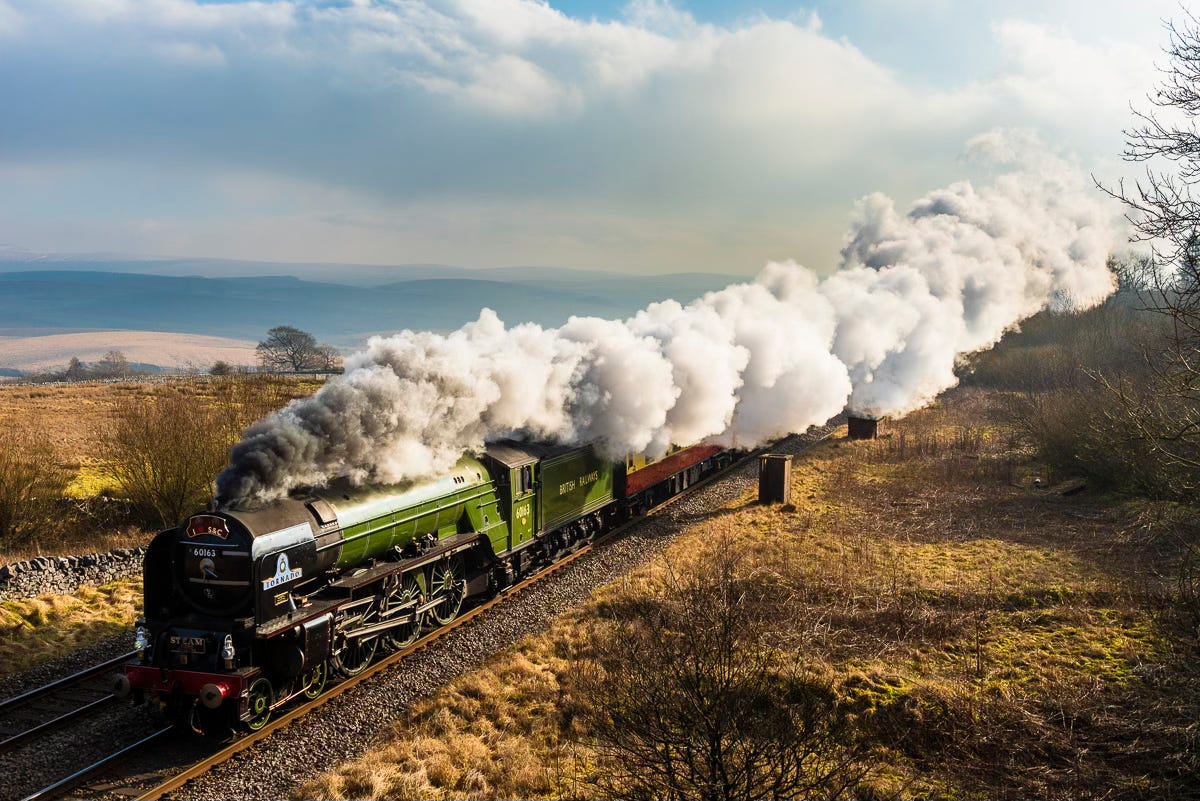
Terry Pratchett, in an uncharacteristically harsh moment, said, "There’s no such thing as writer's block. That was invented by people in California who couldn't write." But Terry began his working life as a journalist on a local paper, back when there were still loads of local papers doing real journalism. You had to get your 200 or 500 words in on time, or you’d be out of a job.
I was never a real journalist like Terry, under those daily time pressures, but I did have deadlines to meet, and word counts to conform to. One of my regular outlets was a magazine called Outdoor Enthusiast (sadly now defunct, like too many other titles). I used to be able to reckon on sitting down and knocking out a serviceable draft in a few hours.
I’d then put it aside for a day or two before a re-read and final edit, taking another hour or two: a luxury unavailable to proper journalists like the young Pratchett, who had to get it right first time. No wonder he later consistently produced at least two books a year. (Actually, I’m currently publishing at that rate, but I’m not writing two novels a year from scratch.)
As a self-published author, I can set my own deadlines, but I do set them. Short of major trauma, Book Four of The Shattered Moon, The Skilthorn Congress, will be published on the 8th of August this year. That’s a promise.
'Depend upon it, sir, when a man knows he is to be hanged in a fortnight, it concentrates his mind wonderfully.' (Dr Johnson.) Deadlines do the same. But fiction writers aren’t continually under the cosh from deadlines like real journalists. Some people set daily targets, but I don’t.
Which leads us neatly on to word counts. I learned a big lesson about these pesky little blighters early on, in fact with my very first published piece.

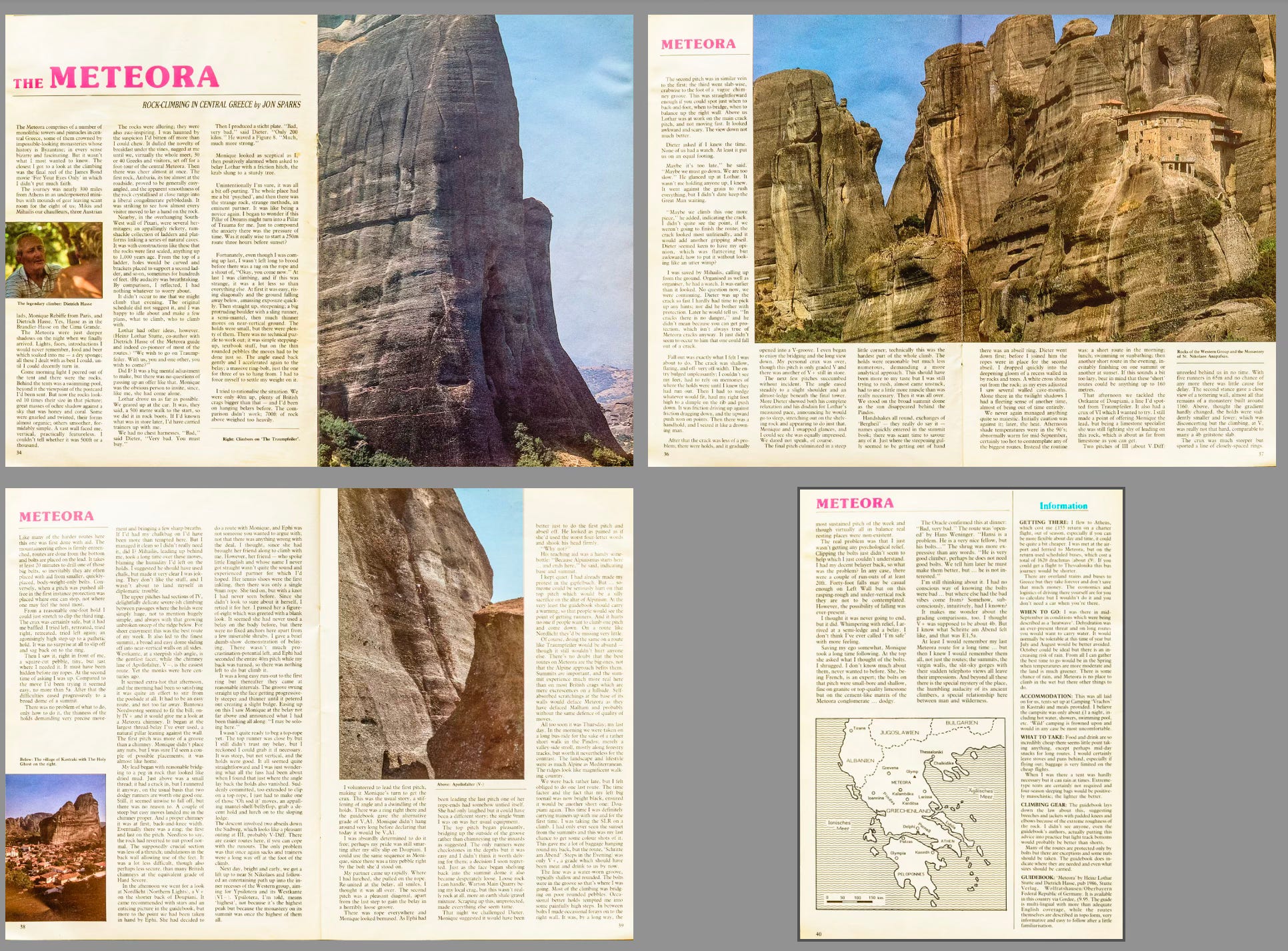
In 1986 I found myself on an international rock-climbing meet in the spectacular location of Meteora in Greece. I'd never climbed outside the UK before, and to heighten my starry-eyed excitement I wound up doing my very first climb there with a famous climber called Dietrich Hasse.
To cut a long story short (because that’s precisely what this story is about) I did a massive head-dump of everything that happened, including detailed accounts of every single route we climbed during the week, typed it up, and sent it off to the UK's leading climbing magazine, 'High'. A few weeks later I got a call from the editor, Geoff Birtles. He wanted to publish it, because it was an area little-known to UK climbers, but…
GB: "Jon, it's nineteen pages long. I'm going to have to make some pretty drastic cuts."
JS: "But you're really going to publish it?"
GB: "Yes, if you're OK with me cutting it."
JS, wanting to dance round the room but limited by the phone-cord: "Yes, please, dear Mr Birtles, whatever you think best, Mr Birtles."
(This may not be verbatim: it was 37 years ago.)
Of course, when the thing finally appeared, I was thrilled—but also slightly heartbroken that he'd cut some of my favourite and most lyrical bits. Never again would I submit any piece of writing without finding out what the word count should be and sticking to it.
The lesson is: kill your own darlings, don’t wait for someone else to kill them for you. Kill the expendables and make the darlings immortal.
The required word count for those aforementioned Outdoor Enthusiast features was 1800. Once I’d done a few, my first draft would consistently be within a hundred either way. This isn’t rocket surgery, as they say. I wasn’t making it up from scratch; usually I was relating a walk, ride or climb that I’d done, or a familiarisation trip to an outdoorsy destination. I’d have been thinking all along about salient points and key moments, and I always had the photos to refer to. But practice counts, and knowing how 1800 words feels is a genuine skill.
However… I regularly see people in Facebook groups asking questions like 'what’s the right number of words for a novel?'. I’ve been tempted to reply that Shakespeare’s vocabulary has been reckoned at about 30,000 words… but that would probably go down like a lead balloon.
Seriously, there are typical word counts for novels, and they vary substantially by genre. Apparently erotica is the shortest (can’t think why, can you?), with a median length among Amazon best-sellers of 58,000 words . Romance and crime/thrillers average around 90k, while the genres that run longest are historical fiction and fantasy, with median length over 100k. However, all genres show a very broad spread, even among best-sellers (for details, including the survey methodology, go here).
From my point of view, as a self-publishing author, I don’t obsess about word count. I’m not a magazine publisher who needs every feature to fit on four or six pages. In general, my attitude is 'let the book find its own length'.
Having said that, at one stage I had a draft of a single novel, then called The Shattered Moon, that ran to 140,000 words. This did seem to be on the long side, and after careful consideration and consultation with my partner, I split it. Further revisions added some length and, I hope, depth; for instance I was able, in Book Two, The Sundering Wall, to flesh out one character’s story, particularly the way he’s torn between promises he made and a new life he’s come to love. Then again, Book Three, Vows and Watersheds ended up a shade over 120,000 and I’m okay with that.
What I don’t do is set myself a daily word count goal. I am pretty sure that it would drive me nuts, and there’d be too many days when I’d be tormented by the whooshing sound of another target flying by. Some days, the writing flows; some days are better spent drawing maps or looking for images for the next cover, or just going for a walk or bike ride and recharging the batteries.
In fact I might just head out right now…

Yes, good advice, especially about daily word count goals and having something else in mind to do that's useful and/or enjoyable (and ideally both)!
This seems like good advice. I always aim to give editors as little work to do as possible, including worrying about whether or not they’ll get my manuscript in time.